Lake Bemidji Wastewater Project
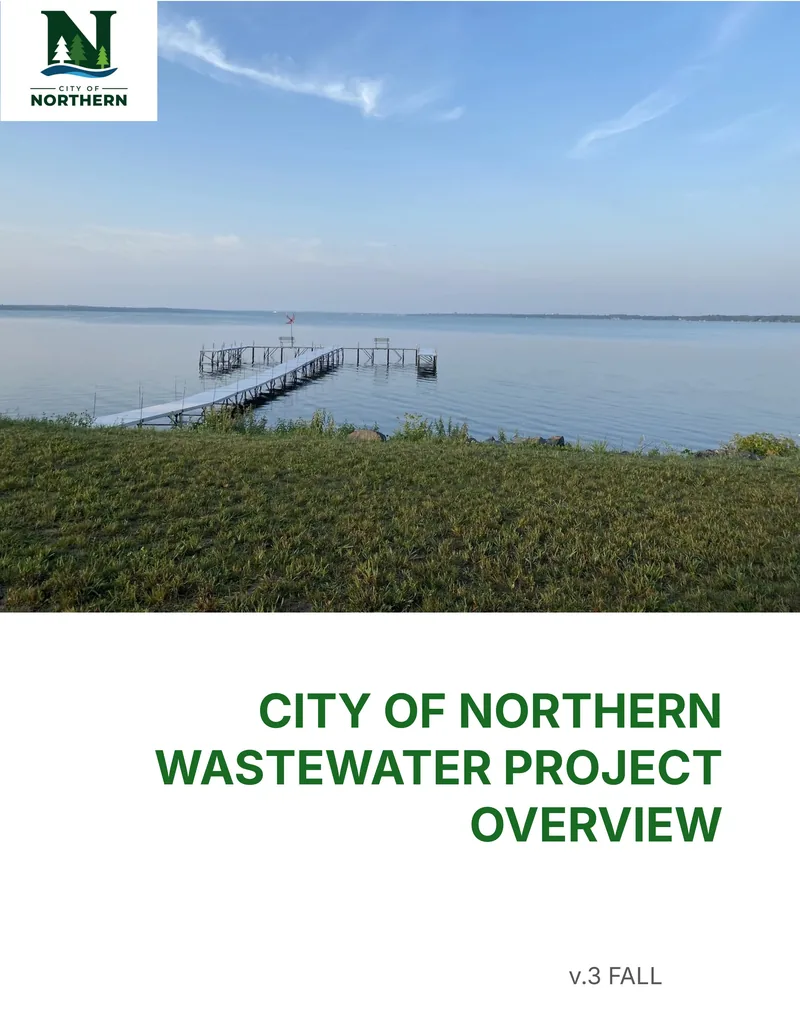
The Lake Bemidji Wastewater Project will bring municipal sewer service to properties around the north and east sides of Lake Bemidji, replacing aging septic systems with a central collection system and treatment plant. The new system is expected to be operational in late 2027 or early 2028. All costs, fees, and dates on this page are projected and may change as bids, grants, and final costs are set.
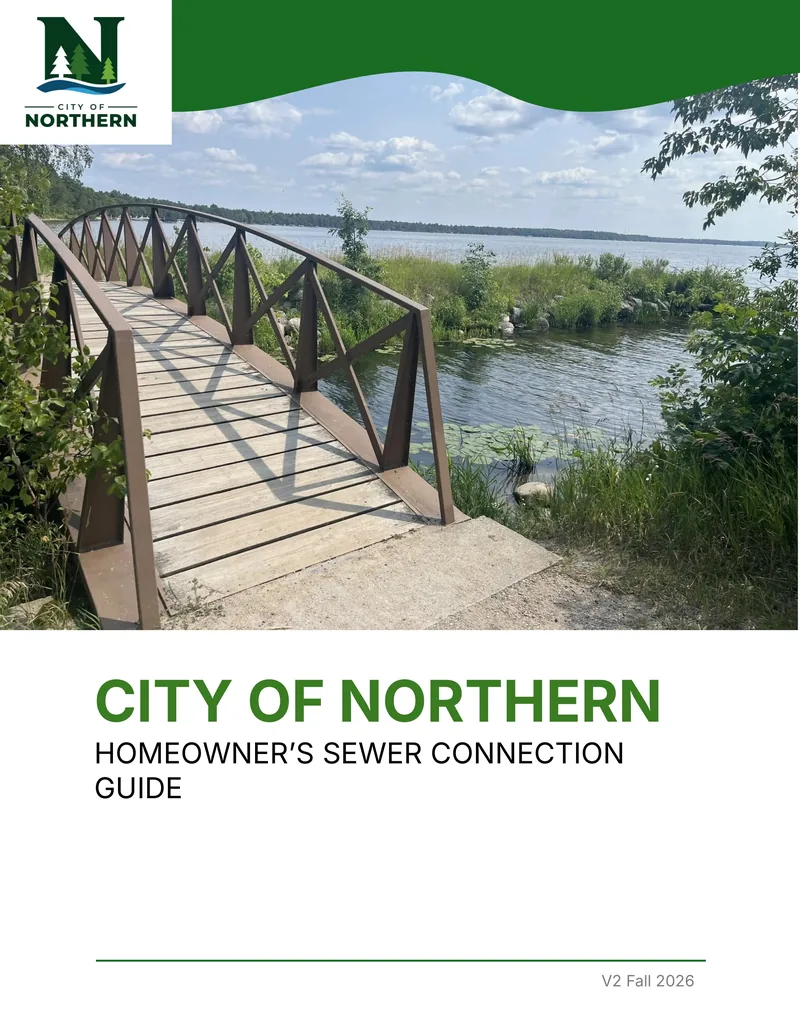
All information on this page is projected. Final assessments, fees, connection rules, and payment terms will be set by the City Council. Resident guides are posted under Project overview.
Project overview
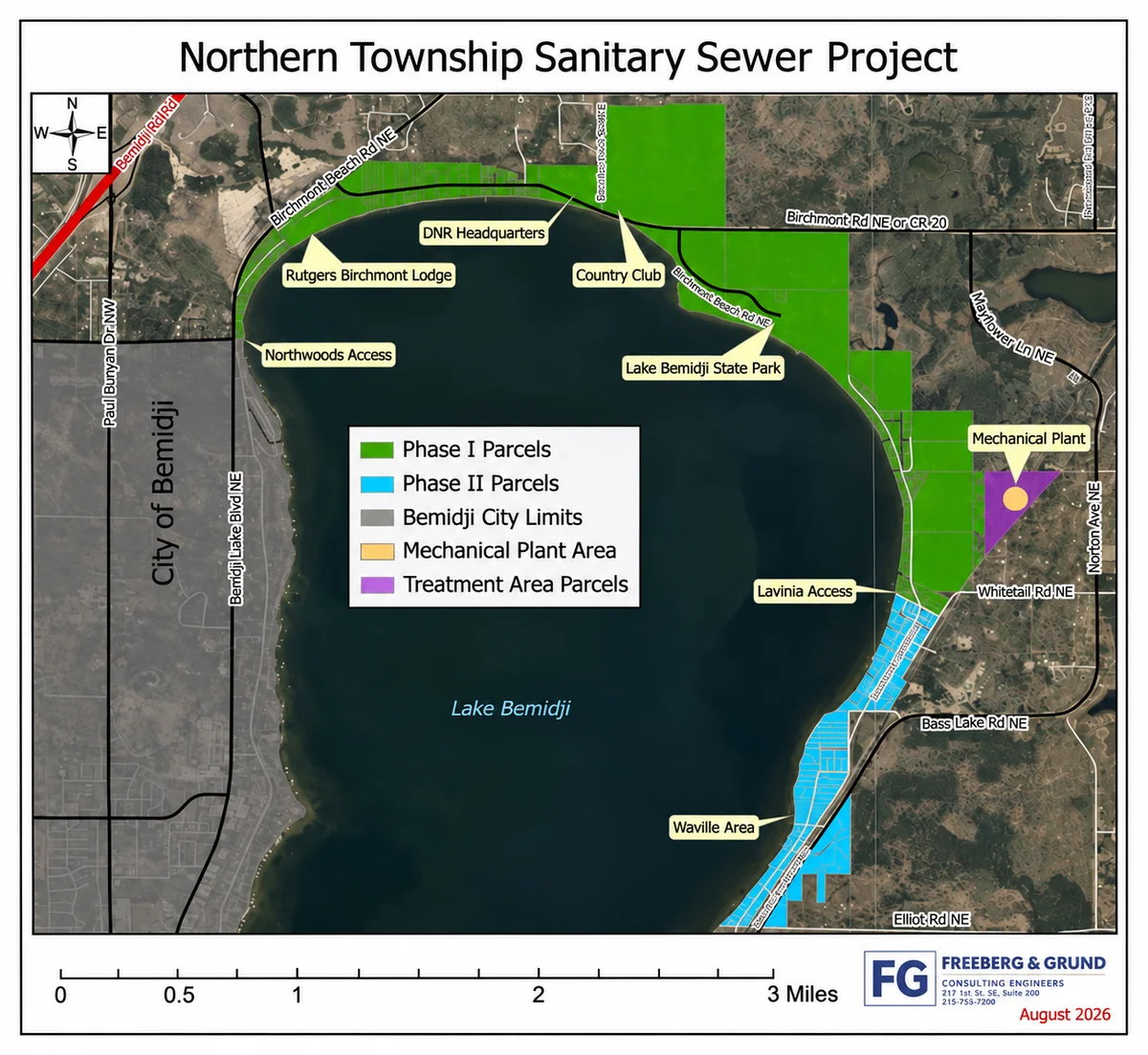
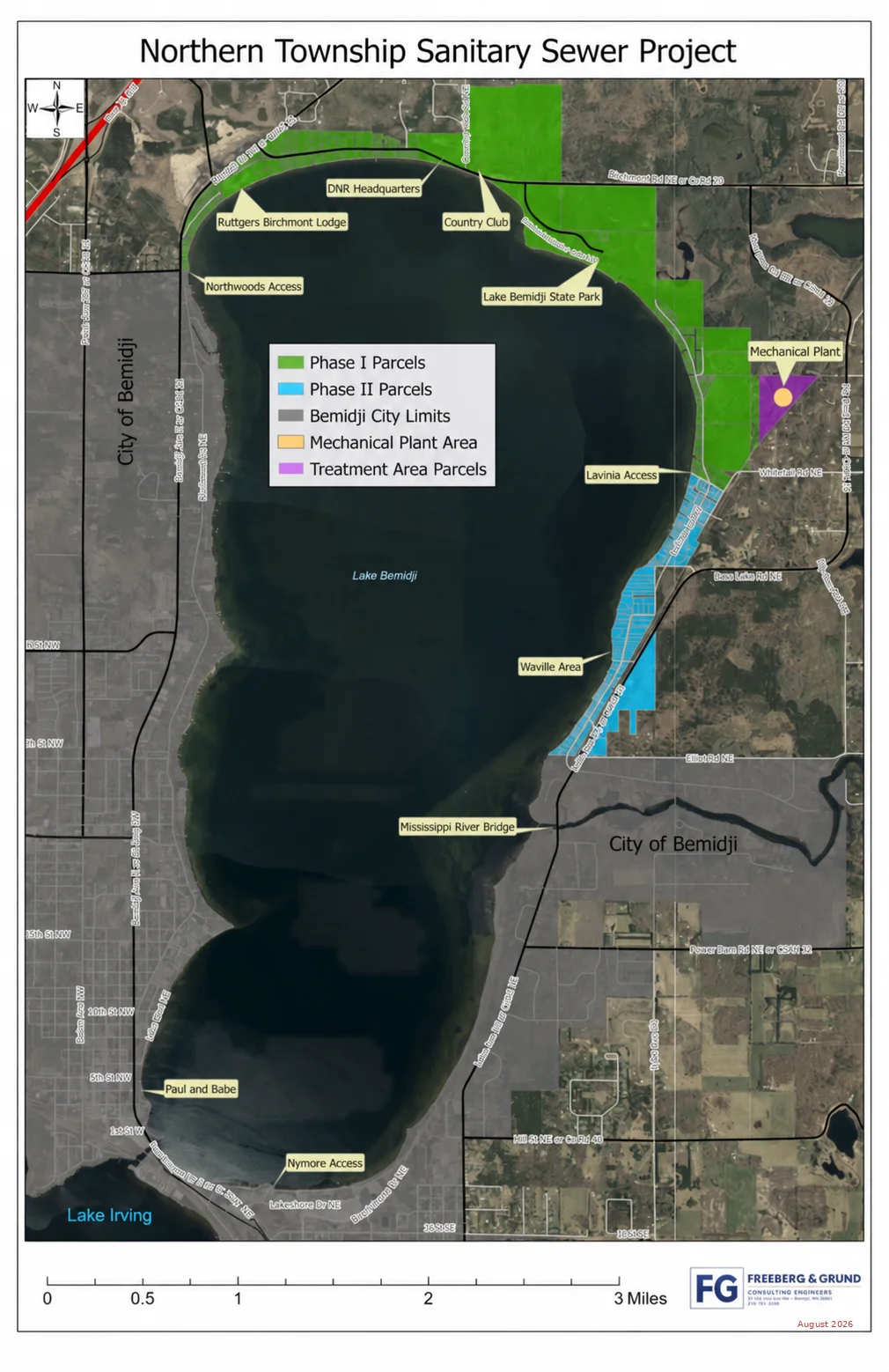
Phase 1 is about 5.8 miles of sewer from the Northwoods Access, along CSAH 20 and through Lake Bemidji State Park, to the Lavinia area. It will serve homes along the route as well as Ruttger's Birchmont Lodge, the DNR Regional Headquarters, the Country Club, and Lake Bemidji State Park.
Phase 2 would extend service south through the Waville area. Phase 2 timing depends on funding.
The treatment plant will sit northeast of the lake, west of the Paul Bunyan Trail, with a new access road to Whitetail Road NE. Treated water returns to the ground on the plant site. It is not discharged into Lake Bemidji or the Mississippi River.
Building the sewer at the same time as Beltrami County's CSAH 20 reconstruction saves the project money compared with building it on its own.
Why the project is needed
Residents and local government have discussed sewer service around Lake Bemidji since the 1960s. Studies over the years have usually recommended a central system.
- Aging septic systems. In the Phase 1 area, 63% of known septic systems are more than 25 years old, and possibly up to 70%, since 30 properties have no septic records.
- Small lots. About 72% of Phase 1 properties (170 of 235) are smaller than the 30,000 square foot shoreland lot minimum for Lake Bemidji.
- Soils and groundwater. Small, densely packed lots with poor soils and a high water table limit how well septic systems can filter nutrients such as phosphorus.
- Known failures. Septic failures have already occurred around the lake.
A central system means one managed system instead of hundreds of individual ones, moves treatment farther from the lake, and treats wastewater to a higher standard. Removing septic systems also frees up space on small lots. With sewer, the shoreland structure setback is 50 feet instead of 100 feet, which would bring most homes in the area into compliance.
A longer explanation of the lake science, including phosphorus, the 2021 Joint Planning Board study, and comments from DNR staff, is on Protecting Lake Bemidji.
Treatment plant
In 2026, after review by the Minnesota Pollution Control Agency (MPCA), the treatment plant design and site were changed. Meeting the MPCA's separation standard at the original site would have required building the drain field up into a mound of roughly 12 acres. The project now uses a Sequox treatment plant by Aero-Mod with rapid infiltration basins at a new site.
- Process. An extended aeration activated sludge process with biological nutrient removal: screening, an anaerobic selector, an anoxic zone, aeration, and a clarifier, all in one common-wall tank.
- Dispersal. Three rapid infiltration basins return treated water to the ground. A winter storage pond of about 8.6 million gallons is used when the basins are frozen.
- Monitoring. Groundwater monitoring wells around the site (five existing, two more proposed).
- Site. About 26 acres west of the Paul Bunyan Trail, to be purchased for about $225,000, about half the size and cost of the earlier plan. The nearest neighbor is more than 1,000 feet away.
Funding
Phase 1 is estimated at about $14.5 million (projected).
The project is funded by federal grants, road funds pledged by the former Township, and property assessments. Grants and road funds total $7.95 million, about 55% of the projected Phase 1 cost. The City is also applying for a state Point Source Implementation Grant (PSIG) and other funding to reduce assessments.
| Source | Amount |
|---|---|
| Congressionally Directed Spending, FY2023 (awarded Dec 2022) | $5,000,000 |
| Congressionally Directed Spending, FY2024 (awarded Feb 2024) | $1,000,000 |
| Congressionally Directed Spending, FY2026 | $750,000 |
| Township road funds pledged | $1,200,000 |
| Total grants and road funds | $7,950,000 |
What it means for property owners
- Assessment. Properties in the service area will be assessed based on Equivalent Benefited Frontage (EBF). The average residential assessment (85 EBF) is projected at about $18,000. The City's goal is to bring that closer to about $14,000 through more grants and competitive bids. Final amounts depend on funding secured and actual construction costs.
- Paying the assessment. You may pay in full or pay over time on your property tax bill. The payback period is not final yet. It is expected to be 15 or 20 years.
- Monthly sewer fee. After you connect, the projected fee is $65 per month per Equivalent Residential Unit (ERU). It covers operation of the system and builds a reserve for future needs.
- Your own connection. You hire and pay a licensed installer for the work on your property. See Connecting to Sewer.
Qualifying seniors, people with a permanent and total disability, and qualifying military members may ask about a hardship assessment deferral under Minnesota Statutes, sections 435.193 to 435.195. A deferral postpones payment; it is not forgiveness. Contact City Hall to ask about applying.
When you need to connect
Connection rules are projected and not final.
- When service is available, the City will send eligible property owners a hookup notice. The base window to connect is 5 years from that notice.
- Anyone may connect sooner. Connecting early is encouraged.
- A property with a newer septic system may be allowed to wait until that system is up to 20 years old.
If you think your property may qualify to wait, contact City Hall. The steps for connecting are on Connecting to Sewer. An updated connection guide is coming.
Schedule
These are target dates from the October 26, 2026 public hearing. They depend on MPCA approval, bids, and coordination with Beltrami County's CSAH 20 reconstruction.
For current construction status, road closures, and how to get updates, see Construction Updates.
| When | Step |
|---|---|
| October 26, 2026 | Public hearing on the proposed improvement |
| Late 2026 | MPCA review and final design |
| January to March 2027 | Bidding and land acquisition |
| March to April 2027 | Contracts awarded |
| April to May 2027 | Bonds sold; construction begins with CSAH 20 |
| Late 2027 or early 2028 | New system expected to be operational |
Public hearing and presentation
The Northern Township Board of Supervisors held a public hearing on the proposed improvement on October 26, 2026. It replaced the December 9, 2024 hearing, because more than a year had passed since that hearing and the treatment plant design and site changed in 2026 after MPCA review.
The presentation covers the need for the project, its history, the updated treatment plant and site, estimated costs and funding, assessments and user charges, the target schedule, and benefits to residents. It was prepared before incorporation and uses the Township name. Figures in it are projections as of October 2026.
Project history
Other options studied included cluster systems, Township-managed septic systems, connecting to the City of Bemidji as customers, orderly annexation, a merger with Bemidji, a pond treatment system, and doing nothing. Each was ruled out, rejected by residents, or not available.
| Year | What happened |
|---|---|
| 1975 | Northern Township Sewer Study (Headwaters Regional Development Commission) |
| 1976 | Beltrami County Sanitary Sewer Study recommends connecting to the City of Bemidji system |
| 2000 | KBM report on cluster systems around the lake |
| 2005 | KBM application to the MPCA for a cluster system on the northwest side of the lake |
| 2012 | Community Action Report on wastewater options |
| 2021 | Ruttger's requests City of Bemidji service; CSAH 20 reconstruction announced; residents reject annexation |
| 2022 | Agreement in principle for customer connection without annexation; first federal grant ($5 million) |
| 2023 | Second federal grant ($1 million); City of Bemidji rescinds its offer; pond option explored, no site available |
| 2024 | Mechanical plant option found viable; first public hearing December 9; project ordered |
| 2025 | Third federal grant ($750,000); plans submitted to the MPCA |
| 2026 | MPCA feedback leads to a redesigned plant and new site; new public hearing October 26 |
Waville Sewer District
The Waville Sewer District is a separate, existing cluster sewer along southern Waville Road. It stays a separate system until Phase 2 of the Lake Bemidji Wastewater Project replaces it.
Questions
For questions about the project, assessments, or connecting, contact City Hall at 218-751-4989 or email info@cityofnorthern.gov. Office hours are Monday to Thursday, 8:00 a.m. to 4:00 p.m. Friday hours vary, please call ahead.
The City Engineer for the project is Mark Fuller, Freeberg & Grund (by contract).
City Hall, 445 Town Hall Rd NW, Northern, MN 56601.
Chris Lahn
City Administrator / Planning Administrator
Phone: 218-444-1857